
WHY THE LSJ?
The obvious swaps for a Fiero are the supercharged SC 3800, an SBC or Northstar V8, or the 3400 — all more common, all well-documented. We're doing something different.
The LSJ is an all-aluminum 4-cylinder, which means a massive weight savings over any V6 or V8 option. That matters a lot here: the Fiero is notoriously rear-heavy, and that imbalance tends to push the front end wide in turns under acceleration. Less weight over the rear axle means better balance, and better balance means a car that actually turns the way an AutoX/track car should.
That's the real goal — something that can run AutoX and track days, still get driven daily, and still look right pulling into a car show. A big, heavy V8 works against that even if it makes more raw power on paper.
There's also just a personal preference for the harder route. This swap has been done before, but it's still uncommon — good LSJ donors aren't easy to find. We got lucky: a whole donor car, Recaro driver seat included (which we're planning to fit into the Fiero too), for $900.
We did seriously consider an easier option: a 3.9L V6 out of a Chevy Uplander, which would have used mostly factory mounts. But we wanted the compact package and simplicity of a 4-cylinder, plus more headroom to mod and make power down the road.
THE PLAN
Before the wrenching starts, here's the full plan for this build — roughly ordered hardest to easiest:
- Mounts: Custom engine and transmission mounts, still to be built. Leaning toward prototyping in-house with 3D printing to iterate quickly before committing to a final version.
- Shifter: The stock shift cable won't work with the F35 transaxle, so cable routing and a shifter redesign are still an open problem.
- ECU: RUSEFI uaEFI standalone ECU, custom tune. Plenty advanced and capable, and still extremely budget-friendly at around $300.
- Wiring: Most non-critical sensors go on a custom CAN bus instead of individual dedicated wires — simpler harness, and way more sensor data available on the dash than a stock cluster could ever show.
- Intercooler: Need a front-mounted intercooler solution to pair with the LSJ's factory water-to-air setup and keep intake temps in check.
- CAN nodes: Still deciding between two setups — ESP32 boards at both ends of the network (engine bay + dash), or an ESP32 at the dash paired with an STM32 in the engine bay for more input pins and expanded capability.
- Dash: Speedometer and tach get replaced by two ESP32-driven round LCD screens, pulling live data straight off the CAN bus.
- Exhaust: Manifold/header solution — found one originally designed for LSJ-powered go-karts that looks like a good fit for the tight engine bay space.
- Fuel: Fuel pump needs an upgrade to support E85. Still deciding between running E85 full-time or building out a proper flex-fuel setup.
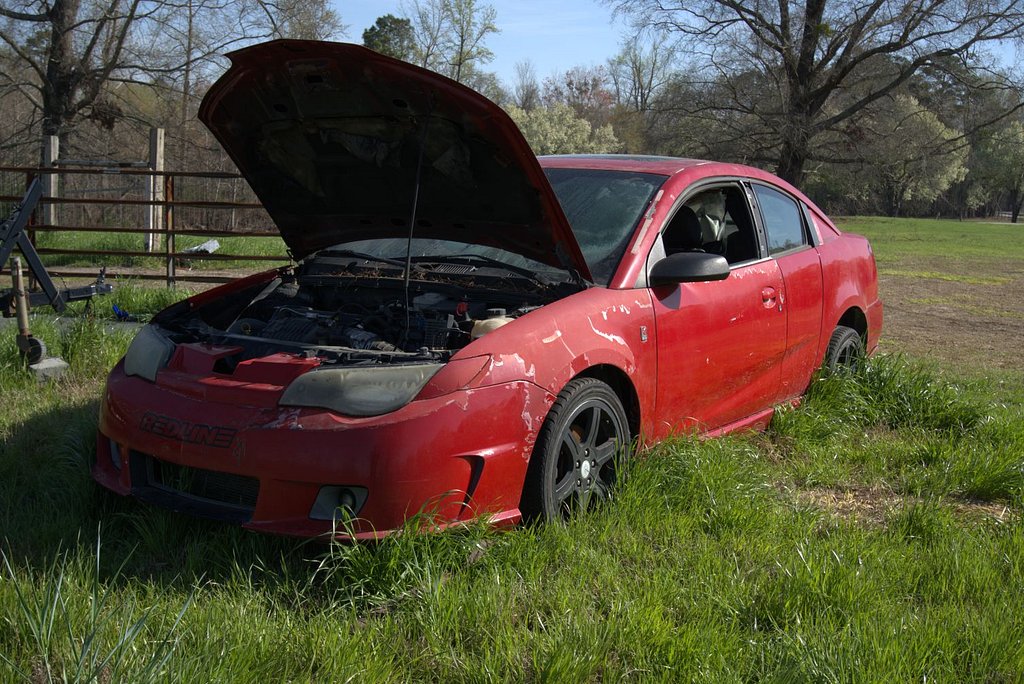
ENTRY 001 — THE DONOR CAR
Every swap starts with a donor, and ours is a red 2004 Saturn Ion Redline. This is the car that makes the whole project possible: it's one of only two GM platforms that came factory with the LSJ — the supercharged 2.0L Ecotec that puts down real power in a small, lightweight package. The Ion Redline was built 2004-2007, and the same LSJ also showed up in the supercharged 2005-2007 Cobalt SS.
Parts pulled so far: the LSJ 2.0L supercharged Ecotec, the F35 5-speed manual transaxle (and we got lucky — this one has the limited-slip differential, not the open diff), and the CV axles, which will bolt right up to the Fiero's rear wheel hubs.
Next up: prepping the Fiero's engine bay for the swap and figuring out mounting. We'll document that as we go, mistakes included.
PARTS PULLED
LSJ 2.0L Supercharged Ecotec
Pulled from our donor 2004 Saturn Ion Redline. Same engine found in the 2005-2007 Cobalt SS.
PARTS PULLED
F35 5-Speed Transaxle (LSD)
Got lucky here — this one has the limited-slip differential, not the open diff. Worth hunting for specifically.
PARTS PULLED
CV Axles
These bolt right up to the Fiero's rear wheel hubs — one less headache in a swap that has plenty of others.